Mining · Investment analysis
Kazakhstan’s mineral wealth: opportunities and incentives for investors
Kazakhstan is one of the few countries that holds much of the periodic table in its own ground. From tungsten and chromium to gold and copper, this wealth offers investors of different sizes concrete ways in – from tailings to deposits with registered reserves.
Let’s talk about your mining investment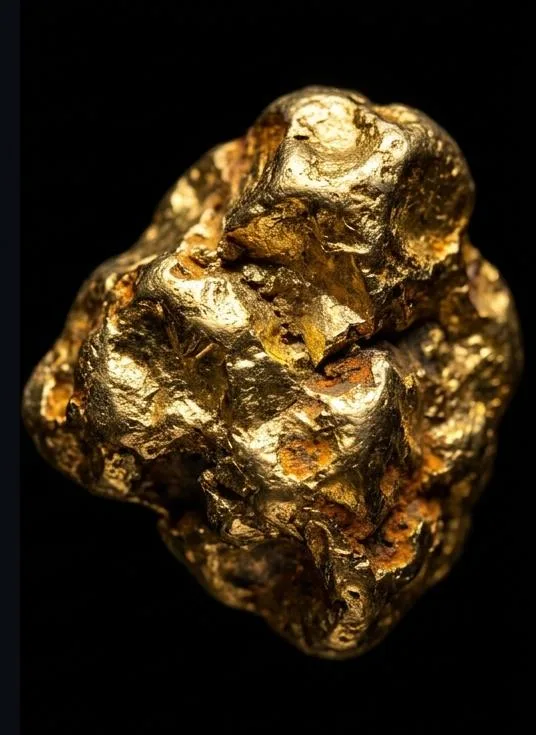
A country in the front row of the world’s mineral map
Kazakhstan’s state balance lists 102 types of mineral raw materials and 987 solid-mineral deposits. Together with oil and gas, mining accounts for about a quarter of the economy and a large share of exports.
The country ranks at the top of the world for uranium, tungsten and vanadium reserves and in the top three for chromium, manganese, silver and lead. It is also a significant producer of copper, gold, zinc, iron and bauxite. The West’s search for supply outside China makes this wealth more valuable than ever.
- mineral types on the state balance
- 102
- mineral types on the state balance
- registered solid-mineral deposits
- 987
- registered solid-mineral deposits
- world rank in uranium, tungsten and vanadium reserves
- 1st
- world rank in uranium, tungsten and vanadium reserves
- exploration licences in force (September 2026)
- 3,236
- exploration licences in force (September 2026)
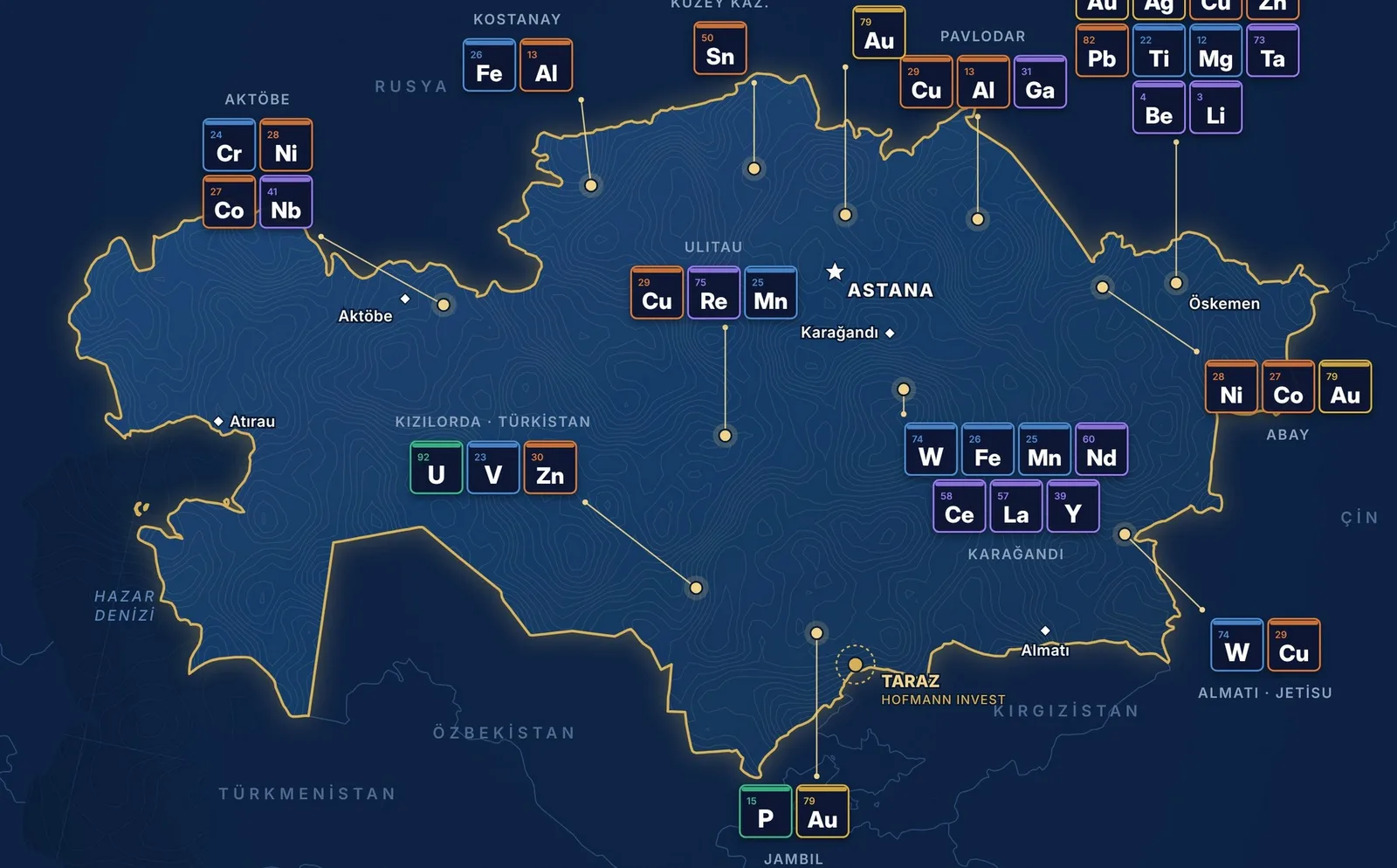
World rank by reserves
- 1stUranium · Tungsten · Vanadium
- 2ndChromium · Manganese
- 3rdSilver · Lead
- 6thZinc
- 8thIron ore
- 11thCopper · Bauxite
- 13thGold
Fast cash, low initial investment: five priority opportunities
The selection rests on four criteria: easy extraction, proven and simple processing (heap leaching, gravity, flotation), liquid sales on the world market and low initial investment. Instead of billion-dollar sulphide megaprojects, the focus is on fields that suit mid-sized investors.
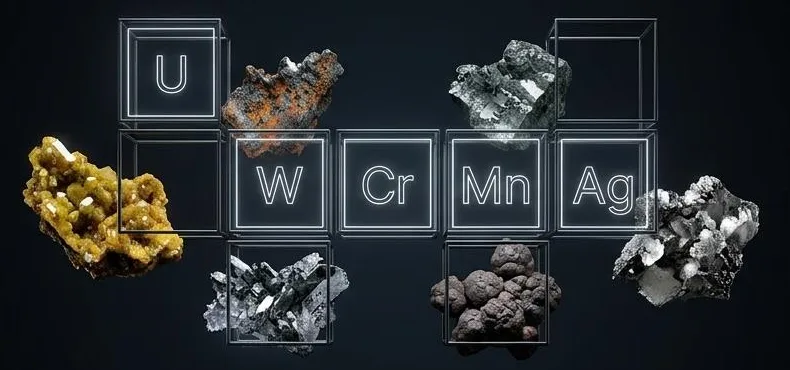
- 1Au
Oxide gold
Guaranteed buyerLow-cost open-pit mining with heap leaching. Refined gold can be sold at the world price thanks to the National Bank’s priority purchase right.
- 2Au · Cu
Reprocessing tailings
Lowest investmentThe ore is already mined and ground; no digging, lowest geological risk. The mineral extraction tax is cut tenfold.
- 3Cu
Oxide copper (SX-EW cathode)
Highly liquidCathode copper from old dumps and oxide ore by leaching and electrowinning – an exchange-traded product that can be sold at any time.
- 4Ag
Silver
No extra investmentA by-product of gold and polymetallic projects; recovered in the same plant, it lifts project revenue.
- 5Cr
Chromite
Straight to industryOpen-pit mining and simple gravity concentration. Kazakhstan holds the world’s second-largest reserves; ferrochrome producers are the buyers.
Second-stage strategic opportunities: tungsten, rare earths, lithium, gallium, rhenium and titanium. Uranium is state-controlled and excluded from the auction system.
Hidden treasure: tailings
Decades of mining have left vast amounts of material waiting to be processed. In 2025 the state completed an inventory of these technogenic mineral formations. Under the new Tax Code in force since 1 January 2026, the mineral extraction tax on metals recovered from them is calculated with a 0.1 coefficient – a tenfold reduction. While developed countries process most such residues, the share in Kazakhstan is still low; that gap is the investor’s opportunity.

- registered tailings sites
- 1,747
- registered tailings sites
- total material (2025 inventory)
- ~55 bn t
- total material (2025 inventory)
- extraction-tax coefficient (from 2026)
- × 0.1
- extraction-tax coefficient (from 2026)
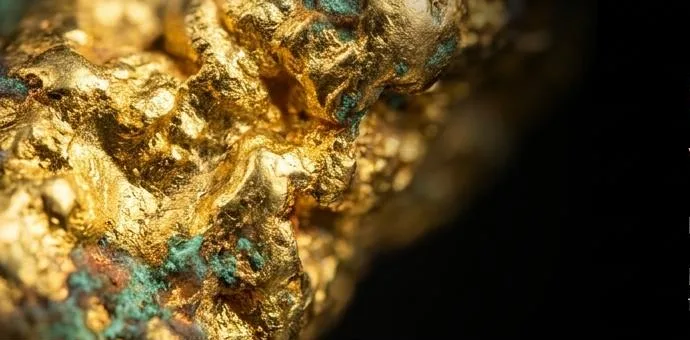
Gold: the metal without sales risk
The National Bank of Kazakhstan has a priority right to buy refined gold from domestic producers at international market prices. For investors this removes the cost of finding buyers and lowers payment risk. The country’s gold reserves are mostly in small and medium deposits – a structure that suits mid-sized investors.
- National Bank gold purchases planned for 2025 (~USD 6 bn)
- ~70 t
- National Bank gold purchases planned for 2025 (~USD 6 bn)
- price paid under the priority right
- World price
- price paid under the priority right
- from licence to first production for oxide gold with reserves
- 2–3 yrs
- from licence to first production for oxide gold with reserves
State incentives: a partner at the investor’s side
Kazakhstan supports new production and processing plants through investment contracts. For a mid-sized gold or copper investor, the most valuable package is a priority investment project contract signed with a newly established Kazakh company.
Priority investment project
For new facilities, up to 10 years’ exemption from corporate income tax, 10 years from land tax and 8 years from property tax.
Customs and VAT exemption
Under the investment contract, duty-free import of equipment and spare parts and VAT exemption on imported raw materials and supplies.
In-kind state grants
Land, buildings and equipment can be transferred to the investor as an in-kind grant.
Tax stability
Up to 10 years of stable tax legislation through an investment obligations agreement – protection against frequent changes.
Special economic zones
Corporate and land tax exemption and customs facilitation for processing plants in SEZs.
International protection
AIFC Court and arbitration centre under English law, ICSID arbitration, bilateral investment treaties.
Tax preferences require most of the company’s income to come from the project and are granted to newly established entities, so a separate Kazakh company (TOO) per project is recommended. The scope and rates of incentives should be confirmed under current law at contract stage.
Mining taxes: the more you process, the less you pay
The royalty system that will replace the mineral extraction tax has been postponed to 1 January 2029 and will apply to new licences. The message is clear: in Kazakhstan, whoever produces metal pays the least tax. Projects that go as far as refining or cathode production therefore stand out.
- Corporate income tax
- 20% · up to 10 years exempt in a priority project
- Production from tailings
- Mineral extraction tax × 0.1
- Planned royalty (2029)
- Ore 13% · concentrate 10% · metal 7%
The road to the site: five entry gates
There is no general restriction on foreign companies acquiring subsoil rights; the applicant’s financial, professional and technical capacity is sufficient. Ranked from low to high risk, there are five routes:
- 1
Tailings processing
A registered technogenic site with a tax reduction; lowest geological risk.
- 2
Deposit from e-auction
Free areas with registered reserves are sold on the state e-auction platform by raising the signature bonus.
- 3
Partnership with a licence holder
Fast entry through a joint venture or share purchase; transfers need state approval and legal due diligence is essential.
- 4
Partnership with the national mining company
Joint development with the state-owned Tau-Ken Samruk.
- 5
“First come, first served” exploration licence
Lowest entry cost, highest geological risk; suited to exploration companies.
- Exploration licence
- 6 years + a one-time 5-year extension; annual minimum exploration spending.
- Mining licence
- Up to 25 years, extendable.
- Timeline
- Preliminary review about 10 working days; 2–3 years from licence to first production for oxide gold with reserves, 5–8 years for large greenfield projects.
Local value added: from ore to product
The state rewards processed products rather than raw ore exports. The buyer map has three poles: China buys volume, Türkiye is a fast-growing metals buyer, and the West and Japan buy critical metals. The fastest value-added opportunities:
- 1
Cable and wire rod from copper cathode
Türkiye is one of the main buyers of Kazakh cathode copper; a plant in Kazakhstan brings logistics and customs advantages.
- 2
Battery materials
Manganese sulphate, phosphate, nickel-cobalt and lithium together: a domestic raw material base for the LFP battery chain.
- 3
Chromium chemicals and low-carbon ferrochrome
Further processing built on the world’s second-largest chromite reserves.
- 4
Recovery from residues and by-products
Gallium and scandium from red mud, rhenium from copper production – low capital, high margin.
- 5
Tungsten and vanadium products
Strategic products that answer the West’s search for non-Chinese supply directly.
What to watch
Regulatory change
Tax and subsoil law change often; contracts with tax stability reduce this risk.
Energy
Electricity prices are rising and grid capacity is limited; energy-intensive processing should plan a renewable component.
Local content
Mining procurement of works and services carries high local content requirements; a strong local supply network is an advantage.
Assay capacity
Precious-metal assay capacity is limited; independent assays in internationally accredited laboratories are recommended.
What Hofmann Invest does
With our team in Taraz we offer mining investors a local partnership from the field to the contract.
- Screening of tailings, e-auctions and partnership opportunities
- Site visits, independent assays and feasibility coordination
- Setting up the project company (TOO) and the investment contract
- Legal due diligence and licence application
- Local procurement, equipment, logistics and buyer contacts
Kazakhstan’s mineral wealth is where it has always been; what is changing are the opportunities the state offers to those who process it. With the right site, the right structure and the right local partner, the most valuable of them are still within reach today.
Let’s talk about your mining investment
Share the mineral, scale and budget you have in mind – together we will identify suitable sites, incentives and the right way in.
- Mineral and site proposals
- Incentive and investment contract options
- Licence and entry timeline
- Local partnership and supply model
Sources: Hofmann Invest, Kazakhstan Mining Sector Investment Report 2026; Ministry of Industry and Construction of Kazakhstan; National Bank of Kazakhstan; Ministry of National Economy of Kazakhstan; invest.gov.kz; The Times of Central Asia; The Astana Times. Images: Hofmann Invest.
This page is for information only and is not investment, legal or tax advice. Figures reflect data at the time of publication and may change.